




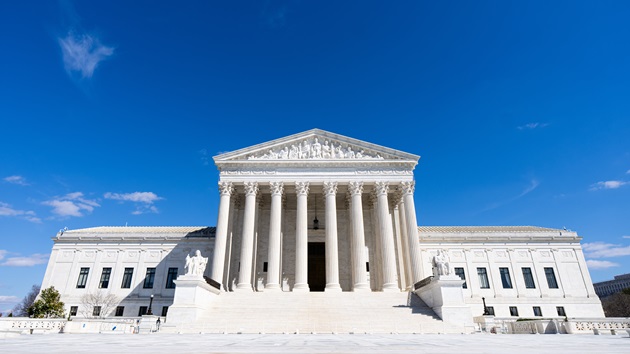
(WASHINGTON) -- The Supreme Court on Wednesday struck down Louisiana's congressional map as an unconstitutional racial gerrymander and dealt a blow to Section 2 of the Voting Rights Act, landmark legislation that has long prohibited election practices that have the effect of diluting the influence of racial minority voters.
In a 6-3 decision, the Supreme Court's conservative majority effectively raised the bar for challenges to election maps that limit the equal opportunity of minority voters to elect candidates of their choosing, even if lawmakers did not have deliberate intent to discriminate.
Justice Samuel Alito authored the opinion, which said that states only violate the Voting Rights Act when "evidence supports a strong inference that the State intentionally drew its districts to afford minority voters less opportunity because of their race."
The ruling reverses lower court decisions that said Louisiana's map, drawn after the 2020 census, violated the Voting Rights Act because only one of six districts was majority Black. More than a third of the state's voting age population is Black.
Those courts had ordered Louisiana to add a second majority-Black district, a process which in turn explicitly relied on race. Alito said that move infringed on the rights of white voters under the 14th Amendment's equal protection clause.
"That map is an unconstitutional gerrymander, and its use would violate the plaintiffs' constitutional rights," Justice Alito wrote for the majority.
"In considering whether the Constitution permits the intentional use of race to comply with the Voting Rights Act, we start with the general rule that the Constitution almost never permits the Federal Government or a State to discriminate on the basis of race," the court added.
In a dissent read aloud from the bench, Justice Elena Kagan said the ruling "renders Section 2 all but a dead letter."
"If other states follow Louisiana's lead," she wrote, "the minority citizens residing there will no longer have an equal opportunity to elect candidates of their choice."
The White House celebrated the Supreme Court decision as a "complete and total victory for American voters."
"The color of one's skin should not dictate which congressional district you belong in. We commend the court for putting an end to the unconstitutional abuse of the Voting Rights Act and protecting civil rights," White House spokesperson Abigail Jackson said in a statement.
Civil rights groups had warned the case could have a catastrophic impact on minority voters' influence across the South and result in reduced minority representation in Congress going forward.
The NAACP called the court's ruling a "devastating blow to what remains of the Voting Rights Act" and "a license for corrupt politicians who want to rig the system by silencing entire communities."
"The Supreme Court betrayed Black voters, they betrayed America, and they betrayed our democracy," NAACP President Derrick Johnson said in a statement. "This ruling is a major setback for our nation and threatens to erode the hard-won victories we’ve fought, bled, and died for. But the people still can fight back. Our best defense and offense is the ballot box, and we’re going to turn out voters in the midterm elections to make sure we can elect representatives who look out for us."
More than a dozen states, mostly in the South, that have court-ordered majority-minority congressional districts could potentially try to redraw their maps to eliminate those districts for political advantage. Most majority-minority districts are represented by Democrats.
It's not immediately clear how far-reaching the ruling in the Louisiana case will be or whether more states will attempt to redraw their maps so close to the November election.
Copyright © 2026, ABC Audio. All rights reserved.

.jpg)