




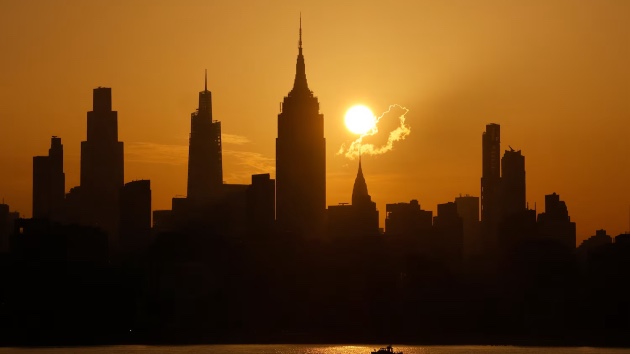
(NEW YORK) -- A dangerous heat wave is bringing prolonged extreme heat to more than two dozen states across the Midwest, the South and the East Coast.
The heat wave began in the Midwest on Monday and has since spread east, where it's set to last into the Fourth of July weekend.
With holiday travel in full effect, Amtrak canceled over a dozen trains in the Northeast Thursday due to the heat.
On Thursday, the heat index -- what temperature it feels like with humidity -- is expected to hit a scorching 111 degrees in Philadelphia and Washington, D.C., 106 in Boston, 102 in Chicago, 108 in Detroit, and 110 in Nashville, Tennessee.
New York City's heat index reached 106 degrees on Thursday. The actual temperature in Central Park hit 100 degrees, marking the first triple-digit day there since 2012.
The city has activated its heat emergency plan and is opening hundreds of cooling centers.
New York City Mayor Zohran Mamdani and New York Gov. Kathy Hochul are also urging New Yorkers to conserve power "due to the increase in energy demand and unexpected load challenges."
"Proactively conserve electricity if safe to do so by setting air conditioning units between 75 - 78 degrees and avoiding unnecessary appliance use," Hochul said.
"I thank New Yorkers for taking these steps to reduce their usage and helping us keep the power on and protect the most vulnerable in our community," she said.
On Friday, the heat index is forecast to hit 108 degrees in New York, 105 in Boston, 112 in Washington, D.C., and 111 in Memphis, Tennessee.
There will be minimal relief overnight, which makes the heat even more dangerous.
On the Fourth of July on Saturday, the heat will improve slightly for the Northeast, but will still feel like the triple digits, with the heat index expected to reach 103 degrees in New York and 107 in D.C.
By Sunday and Monday, the strongest heat and humidity will settle over the Southeast. Raleigh, North Carolina, is expected to feel like 107 degrees and Savannah, Georgia, will feel like 105 degrees.
Extreme heat is the deadliest weather-related hazard in the U.S. At least 13,000 Americans have died from the heat since 2018, according to data from the Centers for Disease Control and Prevention.
Click here for tips on how to stay safe.
Copyright © 2026, ABC Audio. All rights reserved.

.jpg)